
Home > Buying Diamonds with Confidence > What Are the 4 Cs of Diamonds? > Understanding Diamond Clarity: The 4 Cs of Diamonds > Diamond Clarity Scale
Because our focus is always on protecting the consumer, we took the traditional clarity scale one step further than the traditional scales, and added a numerical scale to correspond to the industry standard verbal descriptors, as a 0-10 scale.
We not only wanted to make sure our own practices were as meticulous as possible, we wanted to ensure that the scale was as easy to understand as possible. This extra step means that consumers can feel more confident than ever when making a jewelry investment.
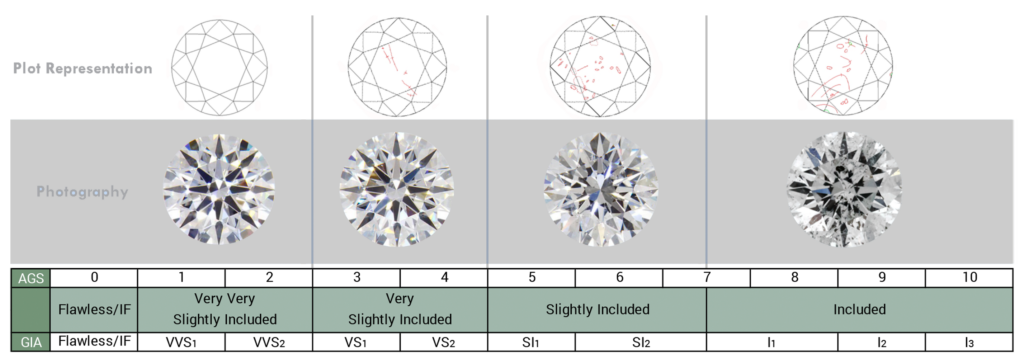
AGS 0: Flawless or Internally Flawless
Flawless diamonds have no inclusions or blemishes visible under 10x. Internally Flawless diamonds have no inclusions visible under 10x, but can have very minor blemishes (marks and features confined to the surface only).
AGS 1 or 2: VVS
A diamond with a clarity grade of 1 or 2 (VVS1 or VVS2) has minute inclusions that are difficult for a skilled grader to see under 10x magnification.
AGS 3 or 4: VS
Very Slightly Included diamonds with a clarity grade of 3 or 4 (VS1 or VS2) have minor inclusions.
AGS 5, 6, or 7: SI
Slightly Included diamonds with a clarity grade of 5, 6, or 7 (SI1 or SI2) have noticeable inclusions that are fairly easy to see under 10x magnification. Sometimes, these inclusions can be visible to the unaided eye.
AGS (7, 8, 9, or 10): I
Included diamonds with a clarity grade of 7, 8, 9, or 10 (I1, I2, or I3), have inclusions that are obvious at 10x magnification. Sometimes, they can be seen with the naked eye. At the lower clarities, may have an effect on the diamond’s durability.
Overall clarity determinations are balanced between the diamond’s appearance face up in the loupe, the microscope at 10x, and eye visibility. Higher power is used to identify inclusions that are otherwise difficult to determine at 10x, which can often include VVS inclusions, however, the final grade is always determined at 10x, in four directions.
Factors that graders consider when determining a clarity grade include the size, nature, number, location, and relief of the inclusions. A diamond receives multiple opinions on the clarity grades it receives, so there is a consensus among expert graders as to what the appropriate grade should be.
AGSL also has implemented quality control mechanisms to ensure consistency in the diamond grading process.
There are five factors that affect how clarity is determined in a diamond, and how inclusions are considered; size, nature, number, location, and relief.
Size
Generally, the larger the inclusion, the greater the impact on the clarity grade. If inclusions are large enough, they can also impact the durability of the stone.
The inclusions with the largest impact on the clarity of the diamond and determine the grade are called “grade setters.” Also, the size of the inclusions and their cumulative effect are considered relative to the size of the stone.
Nature
The nature of an inclusion refers to the type of inclusion it is, and its relative superficiality or depth. Internal characteristics or characteristics that penetrate with depth into the diamond are called inclusions, and features confined to the surface of the diamond that don’t penetrate into the depth are called blemishes. Inclusions that can have an impact on the durability of the diamond are also considered.
Number
For the most part, the greater the number of clarity characteristics, the lower the clarity grade. However, inclusions are not always judged on the number, but on how readily they are visible.
Location
Location is the position of the inclusion/blemish in the diamond. Inclusions closer to the center of the table tend to have a greater impact on the clarity.
Inclusions closer to the girdle (further from the table) are generally more difficult to see, and if they are surface reaching may be at risk for damage.
Inclusions that are positioned near the pavilion have the potential to reflect, as the pavilion facets can act as mirrors, reflecting the image of the inclusion.
Inclusions that are visible when focusing past the culet have less impact on the clarity grade. In addition, the shape, cutting proportions, and facet arrangement can affect clarity grade by obscuring or emphasizing clarity features.
Relief
Relief refers to the distinctness of the inclusion in contrast to the host diamond. The greater the relief, the greater the effect on the overall clarity grade.
Ready to buy? We can help! Or, find a certified AGS jeweler in your area.

Copyright © 2024 American Gem Society